
Project · GSMA IoT SAFE
IoT SAFE Applet
Secure end-to-end IoT communication, rooted in the SIM
IoT SAFE — IoT SIM Applet For Secure End-2-End Communication — is a standard developed by the mobile industry and implemented by Quantag. It lets device makers and service providers use the SIM as a robust, scalable, standardised hardware Root of Trust for IoT data.
- Standard
- GSMA IoT SAFE
- Form factors
- SIM · eSIM · iSIM
- Platform
- JavaCard
- Transport
- (D)TLS 1.2 and 1.3
The problem
Robust and effective IoT security at scale starts with where the keys live.
Leveraging a hardware secure element — a Root of Trust — to establish end-to-end, chip-to-cloud security is a key recommendation of the GSMA IoT Security Guidelines. That requires both provisioning and using security credentials from inside a secure place within the device.
The SIM card or smartcard is best suited to that role: it has advanced security and cryptographic features, and it is a fully standardised secure element, so it interoperates across vendors and behaves consistently for every device maker using it.
IoT SAFE gives that a common mechanism — securing IoT data communications with a highly trusted SIM instead of proprietary, potentially less trusted secure elements implemented elsewhere in the device.
Capabilities
What the applet does
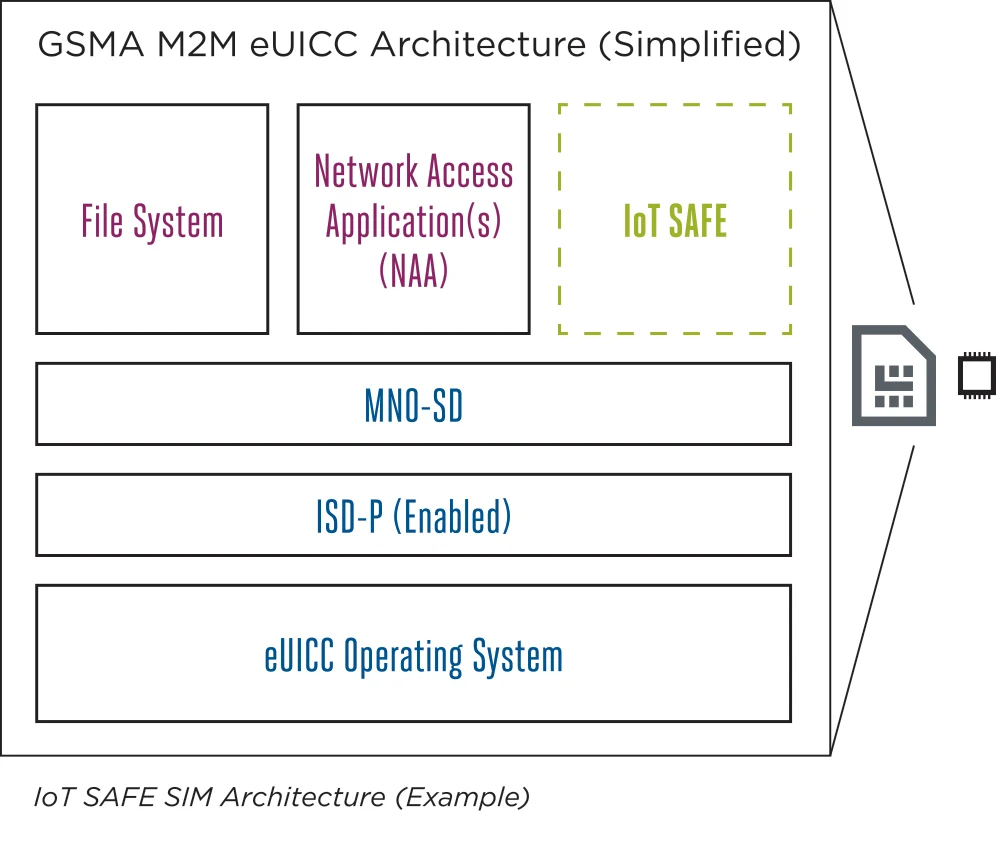
- 01Uses the SIM as a mini 'crypto-safe' inside the device to establish a (D)TLS session with the corresponding cloud application or server.
- 02Compatible with every SIM form factor — SIM, eSIM and iSIM.
- 03Compatible with all JavaCards.
- 04Provides a common API so the highly secure SIM can serve as a hardware 'Root of Trust' for IoT devices.
- 05Helps solve the challenge of provisioning millions of IoT devices.
Security services
What it enables between device and backend
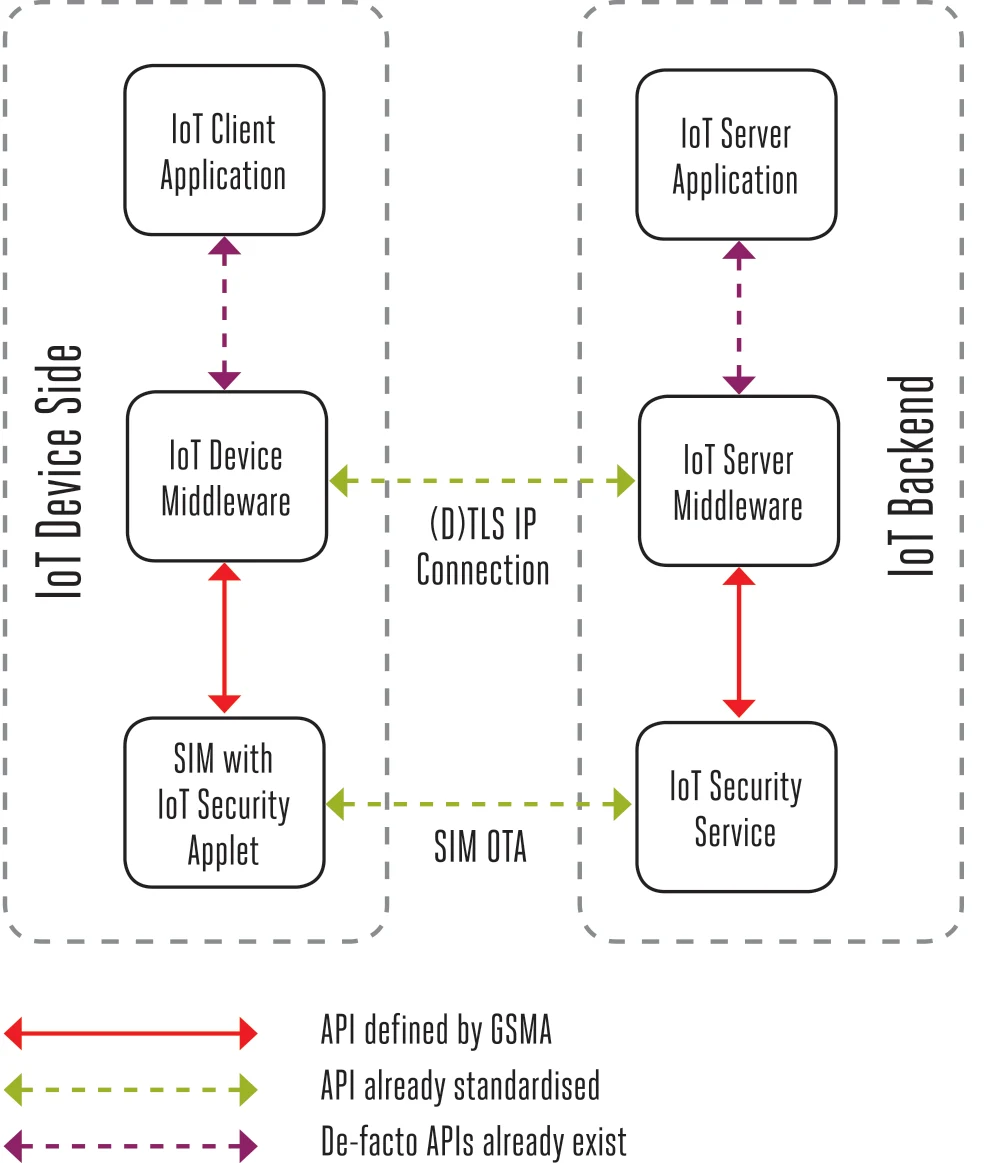
- 01IoT devices perform mutual (D)TLS authentication against a server, using either asymmetric or symmetric security schemes.
- 02Devices compute shared secrets while long-term keys stay secret inside the secure element.
- 03Provisioning and credential lifecycle management run from a remote IoT security service.
Specifications
Two applet builds
| Feature | IoT Security Applet 1 | IoT Security Applet 2 |
|---|---|---|
| TLS version | (D)TLS 1.2 and 1.3 | (D)TLS 1.2 and 1.3 |
| RSA | Yes* (2048 bit) | No |
| ECC | NIST P256 | No |
| ECDHE | Yes | No |
| ECDSA | Yes | No |
| PSK | Yes* (512 bits) | Yes* (512 bits) |
| SHA-256 | Yes | Yes |
| HMAC | Yes | Yes |
| HKDF | Yes | Yes |
* Optional
Building a connected device that has to stay trustworthy?
Applet integration, SIM provisioning, device middleware and the backend it authenticates against — tell us what the device does and we will tell you what securing it takes.